
Best CRM for Marketing Agencies in 2026
Best CRM for Marketing Agencies in 2026
Posted on: September 23, 2026 | Written by: Maria Hart
Picking the wrong CRM can burn months on setup and leave an agency with a client roster nobody actually trusts. What separates the best CRM for marketing agencies in 2026 from generic options is the ability to connect pipeline activity to project delivery, retainer billing, and margin tracking under one roof. The five platforms below cover the realistic range of choices for agencies at different stages and sizes.
What Marketing Agencies Actually Need from a CRM
Most general-purpose CRMs were designed for sales teams pushing product, not agencies juggling ongoing client relationships, scoped projects, and retainer billing at the same time. A CRM built for marketing agencies has to handle contact and pipeline management alongside everything that kicks off after a deal is signed: resource planning, time tracking, and profit visibility. Keep those functions in separate tools, and you get double-entry busywork and a much harder time figuring out which clients are actually making you money.
Agencies shopping this category should weigh how well each tool handles retainer billing flexibility, whether project delivery is native or bolt-on, and how reporting serves both internal ops leads and client-facing account managers.
1. Verbial
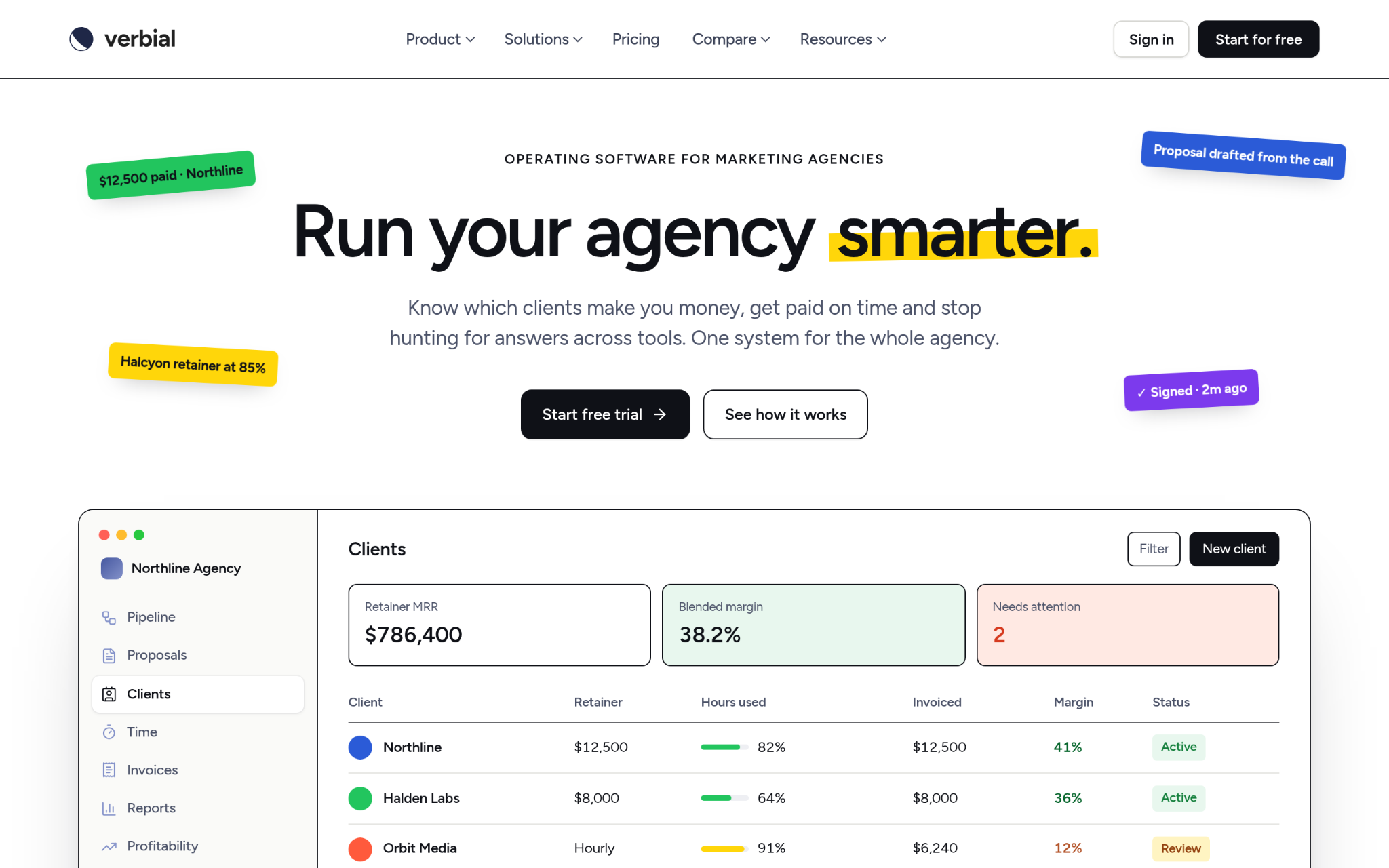
- Best for: Best for: Full-service and 7-8 figure marketing agencies managing mixed billing models
- Standout: Unified CRM, proposals, project delivery, time tracking, and invoicing in one workspace
- What matters: AI-assisted proposal drafting, white-label client reporting, retainer pacing features
Verbial was purpose-built for marketing agencies, and that focus shows in how its features connect to each other. Many CRM for marketing agencies, just like Verbial, manage your pipeline and client contacts, then flow directly into proposal creation with e-signature support (currently in beta) without requiring you to copy-paste data into a separate tool. Once a deal closes, project delivery planning, team time allocations, and retainer pacing all live in the same system. Account managers and ops leads work from the same connected data, with permissions controlling who sees cost and margin. That shared visibility removes the version-control headaches that plague agencies stitching together multiple platforms.
Profit visibility is one of the clearer differentiators here. Margin by client and by team shows up without needing a separate spreadsheet, and the invoicing engine handles mixed retainer, hourly, and project billing on the same account. Free resources like utilization calculators and agency valuation tools are available to prospects, which signals the company understands the day-to-day pressures agencies actually face. A 14-day free trial of the Starter plan is available with no credit card required, while the CRM and proposals are part of the Growth plan (coming soon) and Enterprise.
2. Productive
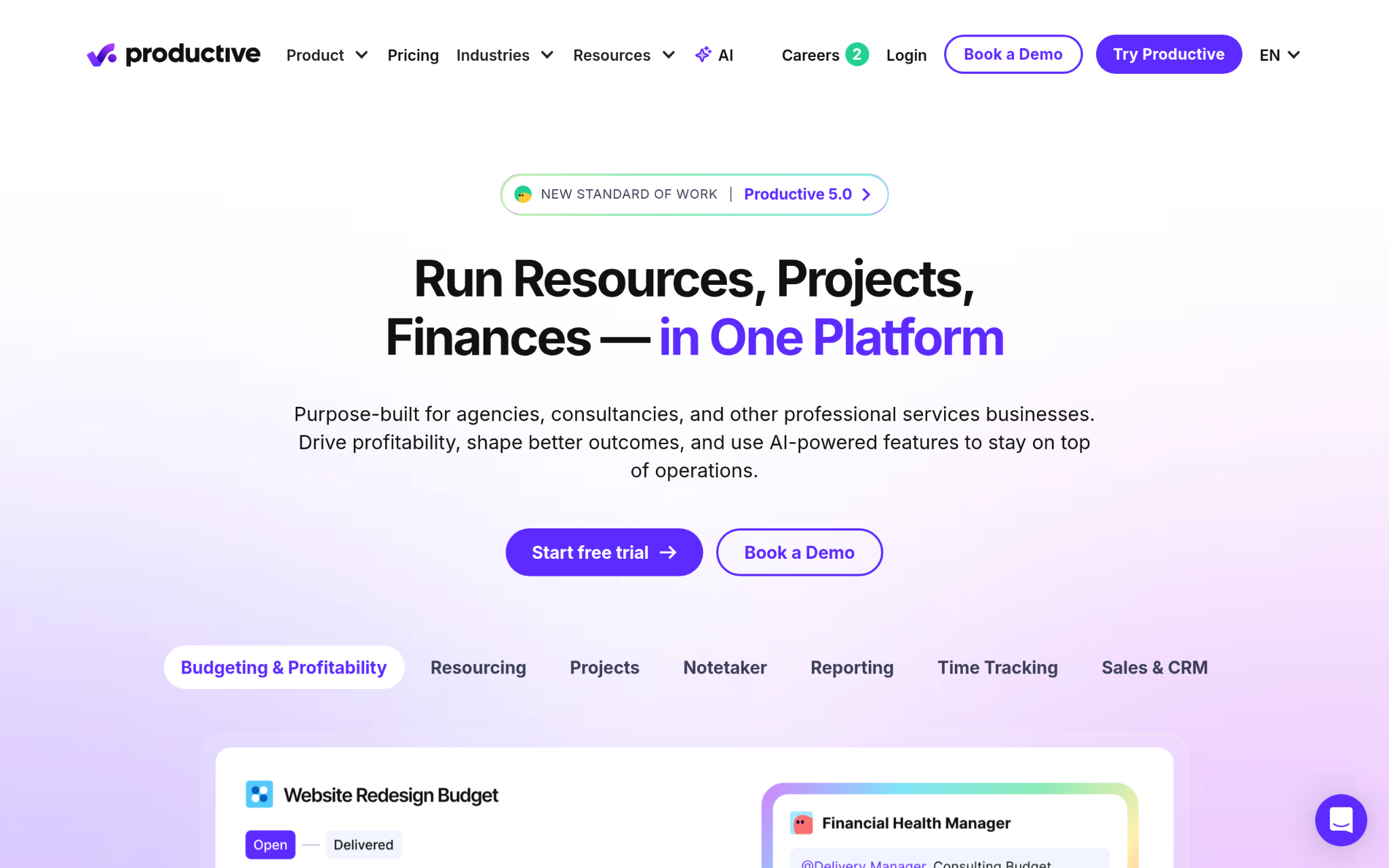
- Best for: Agencies and consultancies that want a self-funded, long-term platform bet
- Standout: Integrated financials including revenue recognition, scenario builder, and profit tracking
- What matters: AI notetaker on the sales CRM; Gantt charts and resource planning native to the platform
Productive launched in 2014, built by a team that had previously run a 350-person design and development firm, so the product reflects genuine operational experience rather than guesswork. It combines resourcing, project management, time tracking, budgeting, invoicing, and a sales CRM inside a single environment. Financial tools go deeper than most agency platforms: the scenario builder and revenue recognition features matter for agencies that need to forecast accurately, not just track actuals. Productive is self-funded and profitable, which tends to mean steadier development priorities. The company serves around 200 customers and has grown its team to roughly 130 people as of 2026, up from 56 in 2023.
3. Scoro
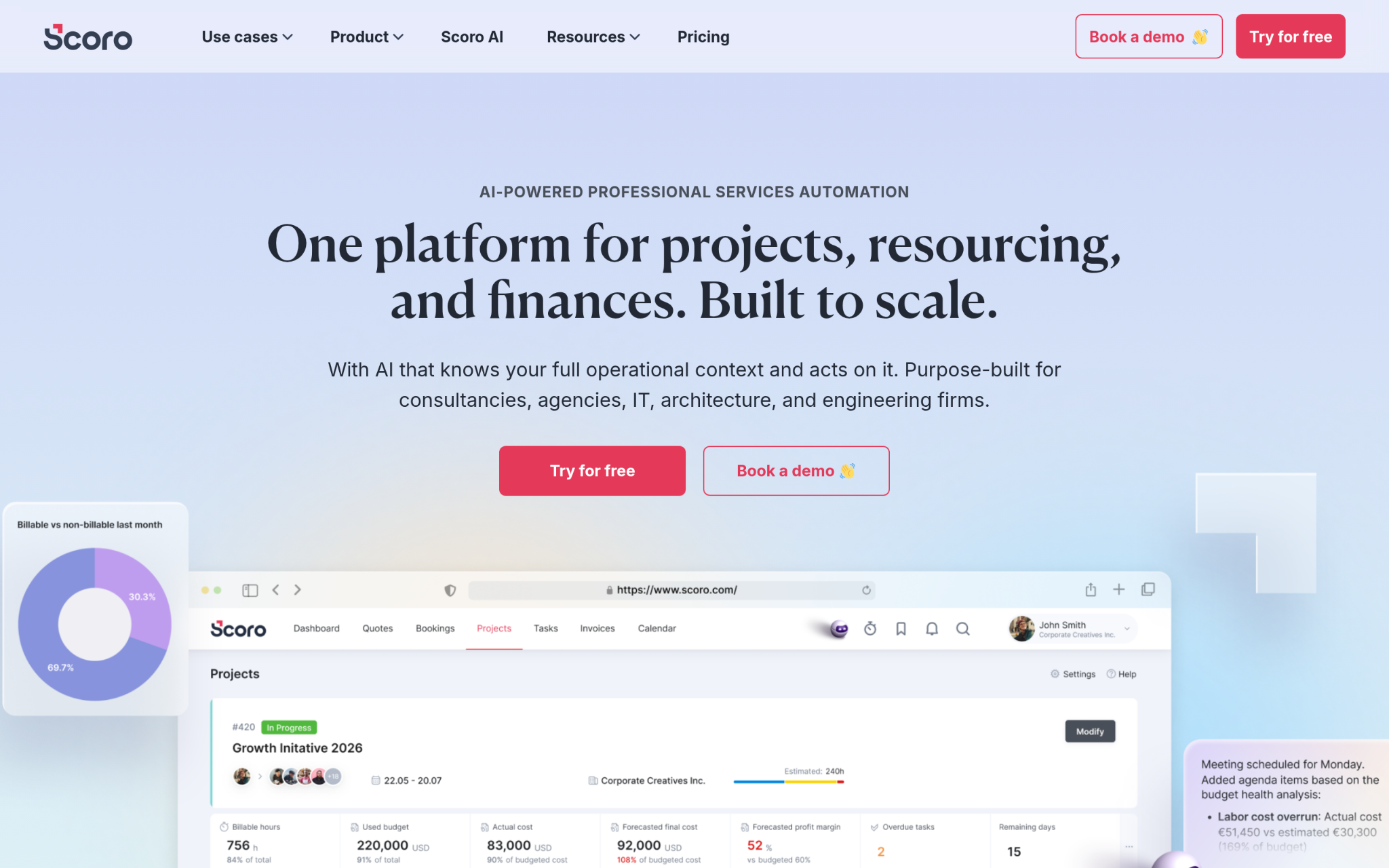
- Best for: Professional services firms in 60-plus countries needing modular PSA software
- Standout: Eight modular applications; customers pay only for the apps they use
- What matters: Real-time linked data across sales, delivery, and financials; case studies include DGA Group and Global Production Partners
Scoro was founded in 2013 in Tallinn and now operates out of London, with additional offices in New York, Riga, and Vilnius. Its modular structure genuinely suits agencies that don't need every feature on day one, teams pick the apps that fit and expand later. Modules span CRM pipeline management, project management, resource planning, time tracking, billing, estimating and budgeting, expense management, and financial reporting. Data links across all modules in real time, so a change in resourcing surfaces in financial forecasts without any manual reconciliation. Thousands of businesses across more than 60 countries run on the platform, and Scoro's 151-person team includes a dedicated sales force.
4. Teamwork
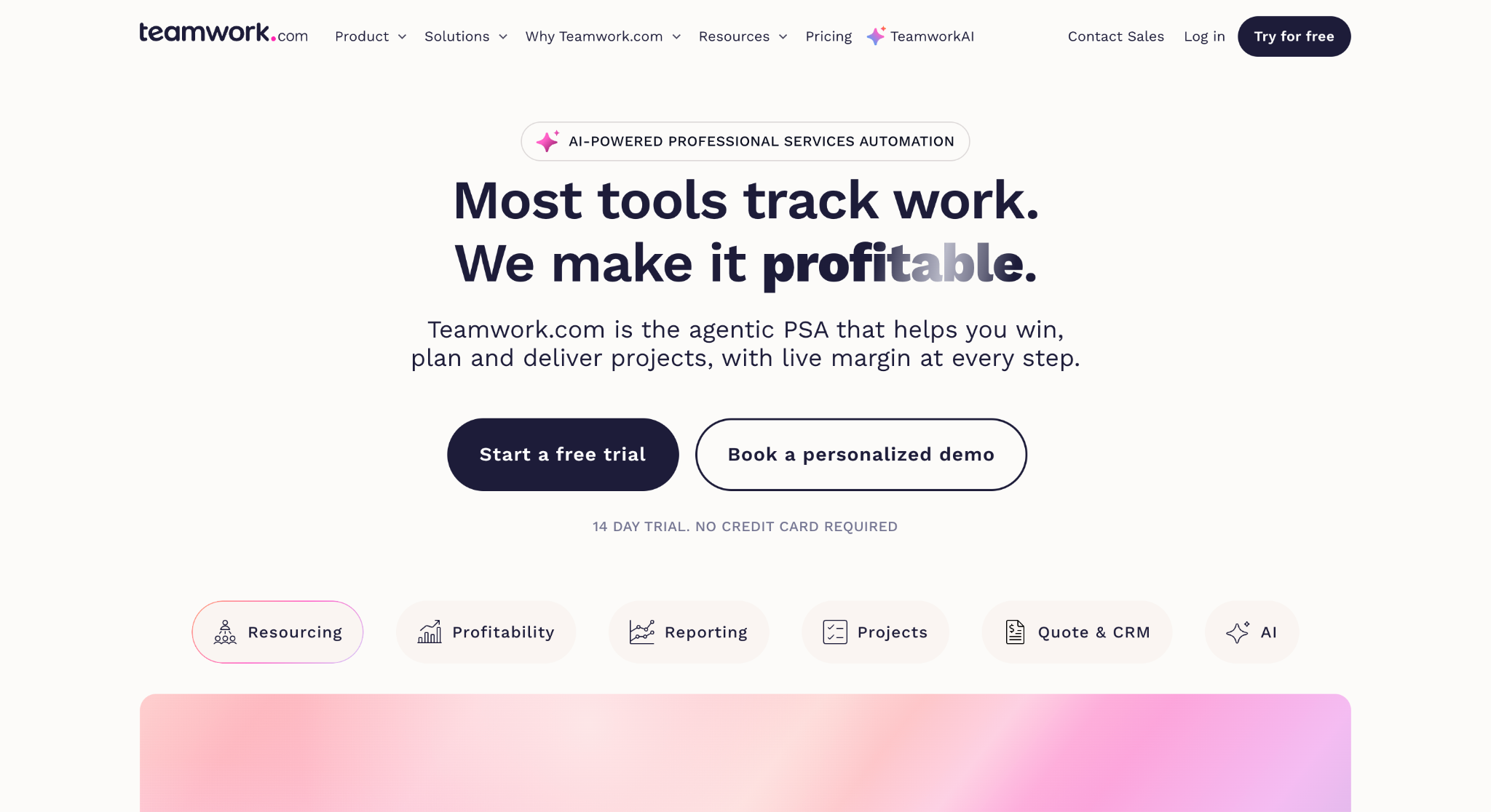
- Best for: Agencies focused on project delivery and client work at scale
- Standout: PSA built explicitly for profit tracking; serves over 20,000 customers including Disney and Spotify
- What matters: Native helpdesk (Teamwork Desk), chat, and CRM alongside project and resource management
Teamwork was founded in 2007 in Cork, Ireland, and has since grown to more than 350 employees across five countries. The flagship platform positions itself as PSA software built for profitability, a framing that resonates with agencies tired of project management tools that ignore the financial layer entirely. It's not just project and resource management, either; Teamwork also includes a CRM, a helpdesk product (Teamwork Desk), and communication tools under the same umbrella. A customer base of 20,000-plus organizations means integrations, documentation, and community resources are well-developed. Agencies managing complex client portfolios, or those handling support tickets alongside project work, will find the broader suite worth the investment. Teamwork Campus One in Blackpool, Cork serves as the main headquarters.
5. Accelo
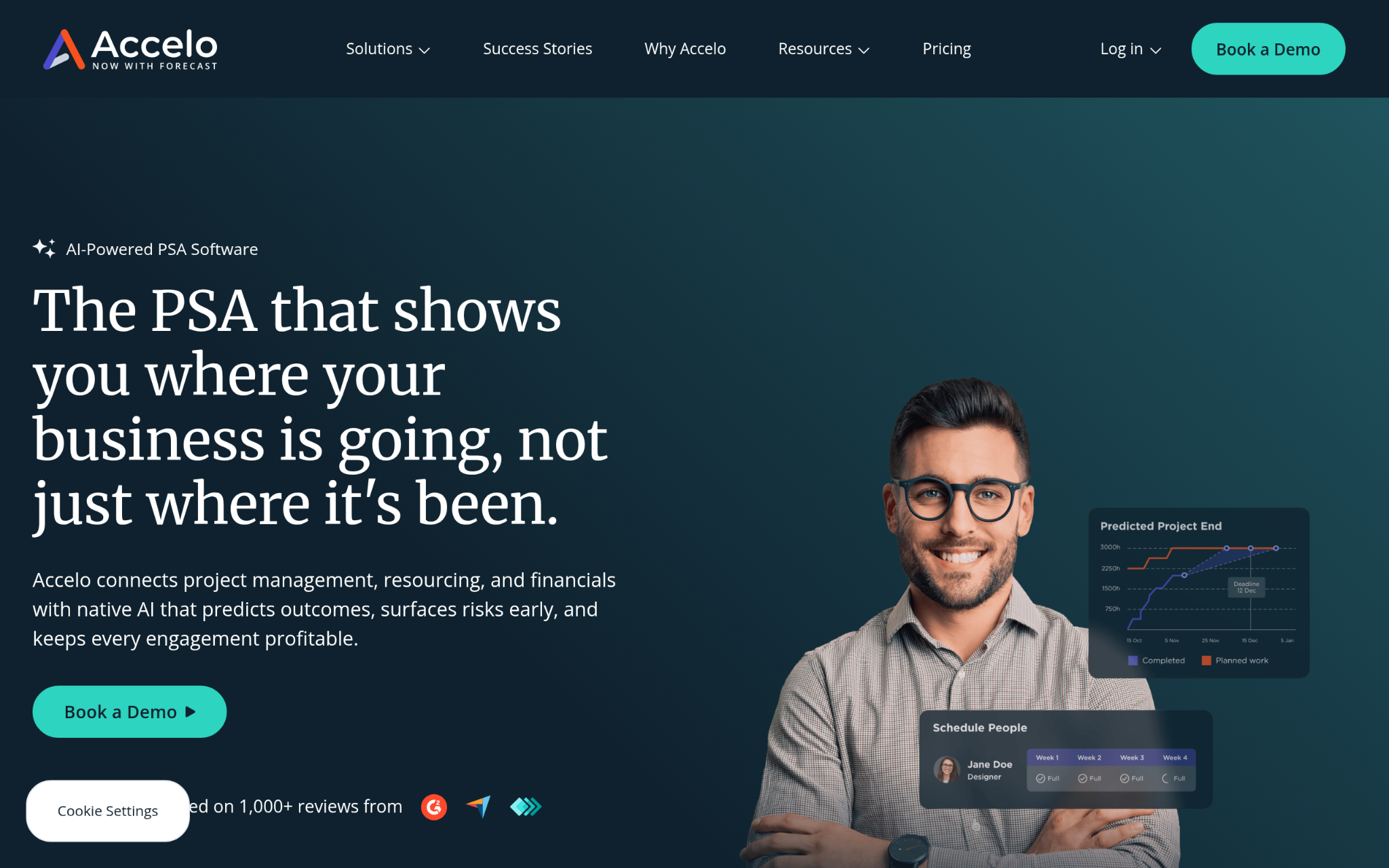
- Best for: Consulting, IT, and agency teams that want predictive AI built into client work management
- Standout: Native AI that predicts project outcomes and surfaces risks during delivery; covers prospect to payment in one platform
- What matters: Offices in Denver (main HQ), Wollongong, Australia, and the UK; serves 100-plus team members globally
Accelo started in 2011 in Wollongong, Australia, originally launching as AffinityLive before rebranding in 2015. The platform covers the full client work lifecycle - sales, projects, tickets, retainers, timesheets, and resourcing - with a specific emphasis on AI-driven prediction. That means the system doesn't just report on what happened; it flags where a project is headed based on current patterns, which gives account managers and delivery leads earlier warning on scope or margin problems. Accelo serves consulting, accounting, architecture, agency, IT and software, and engineering teams. Denver is now the main hub. For agencies that want proactive operational intelligence rather than reactive reporting, the AI layer is the clearest distinguishing feature here.
Bottom Line
Agencies with straightforward needs - a CRM, proposals, time tracking, and invoicing - don't need the most feature-heavy platform on this list. Scoro and Accelo suit teams that want modular flexibility or predictive AI, respectively. Productive and Teamwork are stronger fits for agencies that prioritize financial forecasting or a large integration ecosystem. But the best CRM for marketing agencies in 2026 is simply the one that matches how the agency bills, delivers, and reports, so the evaluation should start there, not with feature checklists alone.
About the author:
Loopex became their first child, raised with patience, commitment, and the occasional sleepless night. (A second child eventually joined the family too, though this one was human.)
Today, Loopex Digital supports 540+ businesses worldwide, works with a team of 100+ SEO specialists across our offices in Los Angeles, US and Yerevan, Armenia, and has helped generate $1.2B+ in revenue across SaaS, B2B, eCommerce, and tech brands.