
How Google Defines Helpful Content
How Google Defines Helpful Content
Posted on: February 17, 2026 | Written by: Ghazy Aziz, Digital Hitmen

The term “helpful content” feels subjective. What one person finds useful, another might not. Google, however, has their own definition.
In this blog, I’ll explain what helpful content is according to Google and outline the signals that Google uses to determines if a specific content is helpful or not.
Quick summary
- • In Google’s definition, helpful content is content that is written for people-first (not search engine-first), satisfies the user’s needs for the query completely and demonstrates expertise and authority
- • Introduced in Google’s Helpful Content Update, it’s important to note that the HCU is a sitewide classifier. This means that it’s not enough that you produce one really helpful content. Ensuring your whole website (overall and on average) demonstrates content to Google’s helpfulness standards is key to be perceived as a source of authority and helpful information.
What does Google mean by helpful content?
According to Google, helpful content is “helpful, reliable information that’s created to benefit people, and not content that’s created to manipulate search engine rankings” (Google Search Central).
Google expects three specific features for something to count as “helpful”:
Key characteristics of helpful content
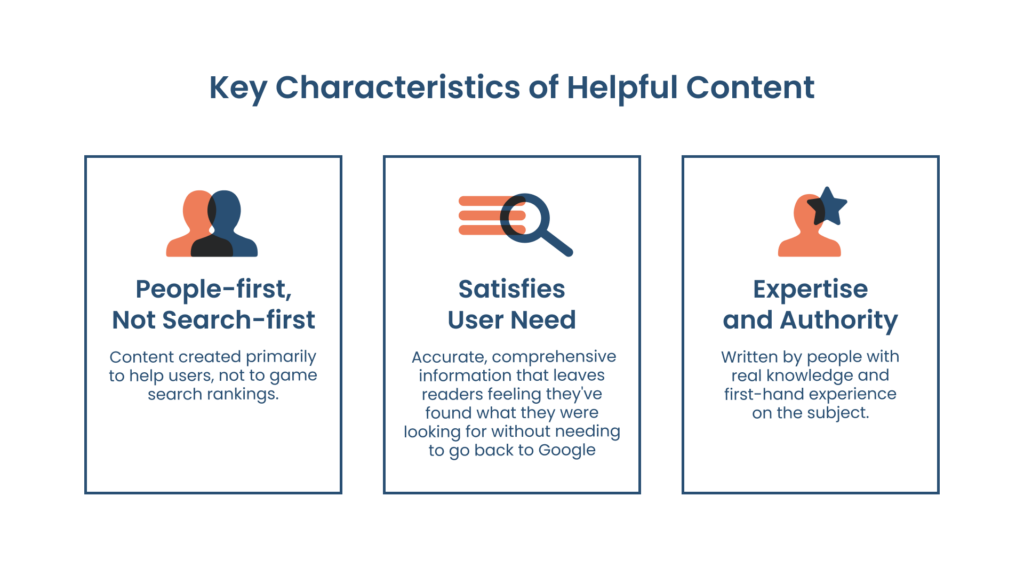
- • People-first, not search-first — Content created primarily to help users, not to game search rankings.
- • Satisfies user needs — Accurate, comprehensive information that leaves readers feeling they’ve found what they were looking for without needing to go back to Google.
- • Expertise and authority — Written by people with real knowledge and first-hand experience on the subject.
How does Google determine what is helpful content?
Here’s the issue: “helpfulness” is inherently subjective. For that reason, Google uses the following criteria to define this more clearly (in their own way) for the purposes of ranking content in search engines.
1. Content that satisfies user needs and search intent directly and satisfactorily
Google considers content helpful if it gives users exactly what they’re looking for.
A query like “how to fix a leaky faucet” has informational intent—the user wants a step-by-step guide. Content that provides this is directly and upfront is helpful. Content that gives a history of plumbing instead beforehand is not.
2. Written for people-first, not search engine-first (user experience)
People-first content is created for actual people, not to manipulate rankings. It’s meant to be written for a reader to benefit and gain value from, instead of writing to stuff keywords for upping your chances of ranking on Google (and not considering the reader at all).
You’re creating people-first content if your site:
- • Has an existing or intended audience that would find the content useful
- • Clearly demonstrates first-hand expertise and depth of knowledge
- • Has a primary purpose or focus
- • Leaves readers feeling they’ve learned enough to achieve their goal
- • Engaging to read or learn from throughout
Search engine-first content is made primarily to gain rankings rather than help people. Signs of this include:
- • Content made mainly to attract search engine visits
- • Producing large amounts of content on many different topics hoping some will perform well
- • Mainly summarising what others have to say without adding value
- • Writing about things simply because they’re trending, without any real interest or expertise
• Google’s ranking systems prioritise content that provides a genuine user experience and benefits people, not content created to manipulate rankings.
3. Content with topical relevance, focus, and freshness
Google evaluates topical relevance through semantic signals—how well your content covers a subject comprehensively. By incorporating a broad range of related terms and topics, you signal to search engines that your content addresses a topic thoroughly, not superficially.
The more relevant your content is to a user’s search, the more it is perceived as helpful.
On an overall domain-level, specific topical focus also matters. Sites that jump between unrelated topics just to chase traffic signal they lack genuine expertise. Staying focused on your niche shows Google your content is based on real (domain-specific) knowledge and and that you’re a source of authority/an expert in your specific niche.
Google also values freshness—regularly updating content to reflect current information signals you maintain your expertise and care about accuracy. Stale, outdated content suggests neglect.
4. Possesses both original value and information gain
Information gain means your content adds something new that other pages don’t already cover.
Google wants to see that you’re not just copying or rewriting what others have already said. Your content should provide original information, reporting, research, or analysis. It should offer more depth or an angle important to the topic that others haven’t considered.
Information gain specifically is an important factor for ranking well—Google prioritises content that adds unique value to the search ecosystem. This becomes even more critical as AI search engines increasingly favor original insights over recycled information.
5. Demonstrates Experience, Expertise, Authoritativeness, and Trustworthiness (EEAT)
Google evaluates whether content demonstrates credibility through four components:
- • Experience – First-hand expertise from actually using a product, visiting a place, or doing the thing you’re writing about
- • Expertise – Content written or reviewed by someone who demonstrably knows the topic well
- • Authoritativeness – The content creator or website is well-trusted or widely-recognised as an authority on the topic
- • Trustworthiness – Information presented in a way that makes you want to trust it (clear sourcing, evidence of expertise, author background)
Why Google now emphasises helpful vs unhelpful content
Google’s Helpful Content Update, introduced in August 2022, addressed a growing problem: too much content was being created for search engines first (for the sake of chasing rankings by gaming search engines), not people.
This became especially important as AI made it easier to produce mass AI-generated content at scale.
Initially, this system acted as an additional sitewide signal. Over time, Google integrated it into its core ranking systems, meaning it now continuously influences rankings across all queries and languages.
Here’s why Google made this distinction clear:
1. To reduce low-value SEO-first content
Too much content ranking well was made to game SEO signals, not to serve people.
With the growth of automation and AI, producing SEO-first, low-value pages at scale became easier. Google had to strengthen systems that filter them out.
“We know people don’t find content helpful if it seems like it was designed to attract clicks rather than inform readers… The helpful content update aims to better reward content where visitors feel they’ve had a satisfying experience, while content that doesn’t meet a visitor’s expectations won’t perform as well.” — Google Search Central Blog, Helpful Content Update (2022)
2. To ensure people get satisfying answers the first Time
If users have to “search again” after clicking a result, Google sees that as failure.
Machine-generated content at scale often leaves gaps or padding that fail to satisfy. Google needs systems that can continuously detect and down-rank it.
“The helpful content system is designed to ensure people see content that leaves them feeling they’ve had a satisfying experience.” — Google Helpful Content System explainer
3. To protect original, people-first work
Google wants to reward original reporting, research, and genuine expertise rather than letting mass-produced or automated content farms dominate results.
By applying a site-wide machine learning classifier, it ensures creators of original content aren’t drowned out by scaled-up “search engine–first” pages.
“This update introduces a new site-wide signal… Our systems automatically identify content that seems to have little value, low-added value or is otherwise not helpful to people.” — Google Helpful Content System explainer
How well Google actually fulfils their promise of lifting original, helpful content can be debatable, but their intent is clear. In March 2024, this update became part of Google’s core ranking systems, meaning:
- • The update most likely won’t be rolled back
- • Subsequent algorithm updates aim to improve Google’s capability in surfacing helpful content through a variety of signals and systems
Our tips for creating helpful content
Now that you understand what Google considers helpful, here’s how to optimise your content.
1. Align content with user search intent
The gist of this is you understand exactly what a reader is looking for when they type their query in search, and you address this immediately and clearly to give them what they want.
To self assess, consider reviewing your content and ask yourself:
- • Analyse your topic’s query and search intent. What is the one thing a reader will want to take away from this search?
- • Can they find the answer to what they’re looking for in your content easily?
- • Study the page 1 search results for your target keyword. What’s currently ranking? That usually shows what Google expects content to have or address.
- • Depending on the search results, the content format also matters. For example, videos may rank better than articles for some “how-to” topics, so your strategy needs to change accordingly.
- • Put yourself in the user’s shoes. Read through your content and ask: does this give what readers are looking for?
2. Genuinely create people-first content that’s engaging to read
Read through your content and answer these questions from Google’s own Helpful content evaluation guide:
- • Do you have an existing or intended audience that would find the content useful if they came directly to you?
- • Will someone reading your content leave feeling like they’ve had a satisfying experience?
- • Will someone leave feeling they’ve learned enough to achieve their goal?
What NOT to do:
- • Don’t create content primarily to attract search engine visits
- • Don’t just summarise what others have said without adding value
- • Don’t write about things simply because they’re trending
- • Don’t leave readers feeling like they need to search again for better information
In addition to the points above, you can satisfy this further by making your content more engaging to read overall.
Tables for comparisons, bullet points and numbered lists to break up text, the use of multimedia, breaking up paragraphs and using proper header structuring to make it easier to read, and so on.
If you’re interested in learning more how to write helpful SEO content, check out our essential SEO content writing guide for beginners.
3. Optimise content for relevancy and specificity
On an article level
- • Include your target keyword or topic in the important areas: title tag, H1 (blog title), H2 (first header) and first sentence/paragraph.
- • Make sure your header structure (H2s, H3s) is focused and on topic. These represent your outline for answering the article title.
- • Use semantically related keywords throughout. If you stay on topic, you’ll naturally cover most of this without needing external tools (though tools like Surfer or Frase can help).
On a domain level
- • Define your primary purpose and target audience. Make it clear what specific area of knowledge or service you cover and who you serve.
- • Avoid sprawl. Don’t produce lots of content on many different topics hoping some will perform well in search results.
- • Build authority for your relevant niche/topic.
4. Include real and valuable information gain
- • Provide original information, reporting, research, or analysis
- • If you’re drawing on other sources, don’t just copy or rewrite them. Add substantial value and originality.
- • Ask yourself: does your content have additional value (more depth, a different angle) compared to other pages in search results?
Think of it like this. Why should someone read your content if it only repeats what’s already out there?
To truly be helpful (and to give Google a reason to rank your article over others), you need to add value through original insights, real expertise, or practical application others haven’t covered.
Otherwise, there’s no real incentive fog Google to rank yours over something that covers everything you’ve said already, and for users to read your version when everything that’s there has been covered by another.
5. Demonstrate strong EEAT
EEAT stands for:
- • Experience – Clearly demonstrate first-hand expertise. Show that you’ve actually used a product, visited a place, or done the thing you’re writing about.
- • Expertise – Make sure content is written or reviewed by someone who demonstrably knows the topic well. Demonstrate expert insight within the content itself.
- • Authoritativeness – Show that you or your website is well-trusted or widely-recognised as an authority on the topic through clear background and credentials.
- • Trustworthiness – Present information in a way that makes readers trust it. Use clear sourcing, show evidence of your expertise (like documenting your process), and include background about the author or site (links to author page or About page).
To learn more about EEAT, you can find out everything you need to know in our handy guide: What is EEAT?
Examples of helpful content from our work
Here are some examples of helpful content we’ve created that demonstrate these principles in practice.
1. Adding originality through case studies to idea listicle content
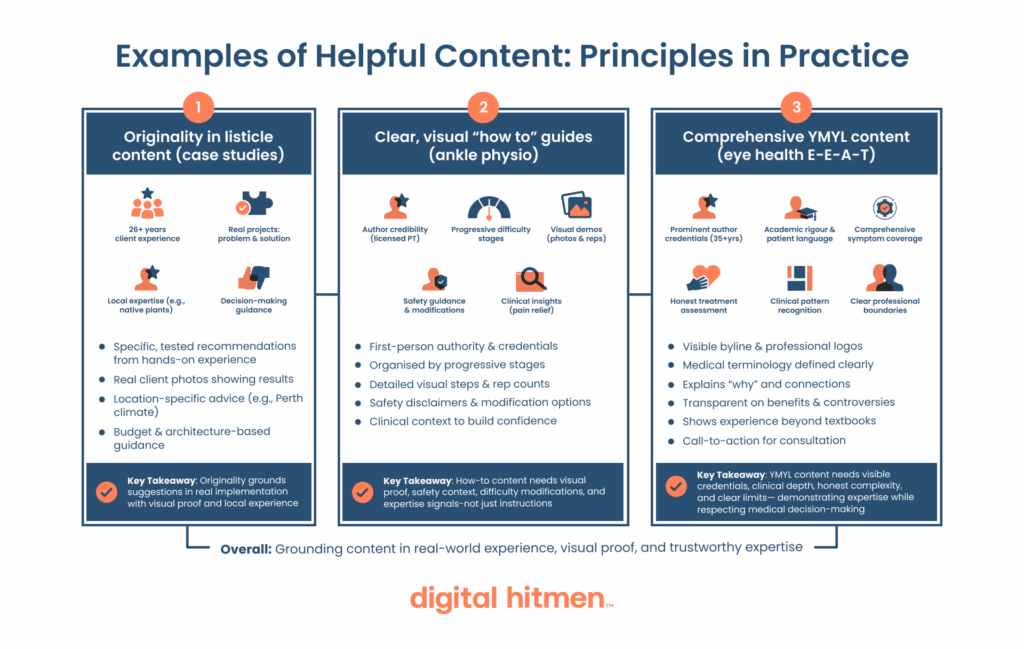
Idea listicles are easy to generate but often lack practical application. For this patio enclosure ideas blog, we demonstrated originality by:
- • Drawing on the client’s 26+ years of hands-on experience with Perth homes to provide specific, tested recommendations rather than generic suggestions
- • Including real client projects with photos showing the problem, solution, and result (e.g., retractable blinds for a homeowner wanting flexibility between sun and shade)
- • Providing location-specific expertise like recommending native Australian plants that actually thrive in Perth’s climate
- • Adding decision-making guidance to help readers choose between options based on their budget, architecture, and goals
Key Takeaway: Originality comes from grounding suggestions in real implementation with visual proof and local expertise.
2. Improving “how to” guides with clear, easy-to-follow steps and photos for illustration
To properly target “how to” queries, you need more than steps. For this ankle physio exercises blog, we created truly actionable content by:
- • Establishing author credibility with first-person authority (“I’ve seen amazing recoveries…”) and credentials (licensed physiotherapist James Fannon)
- • Organising by progressive difficulty from non-weight-bearing exercises to advanced plyometrics, helping users find their appropriate stage
- • Providing detailed visual demonstrations with 2 photos per complex exercise, numbered steps, hold times, and rep counts
- Including safety guidance with professional disclaimers, modification options (“If too difficult, try from sitting position”), and pain warnings
- • Adding clinical insights throughout (“Many clients report pain relief with this exercise”) to build confidence
Key Takeaway: How-to content needs visual proof, safety context, difficulty modifications, and expertise signals—not just instructions.
3. Demonstrating knowledge in a difficult health topic with clear sourcing, academic referencing and covering key patient concerns
YMYL (Your Money or Your Life) content faces Google’s highest scrutiny. For this complex eye health topic, we demonstrated comprehensive E-E-A-T through:
- • Prominent author credentials including byline, professional photo, 35+ years experience, and professional association memberships with logos
- • Academic rigor made accessible by using proper medical terminology then immediately defining it in patient-friendly language
- • Comprehensive symptom coverage explaining not just what symptoms are, but why they occur and how conditions connect
- • Honest treatment assessment including both benefits and medical controversies (“There is controversy on…opinions vary”), building trust through transparency
- • Clinical pattern recognition woven throughout (“An adaptive change often observed…”) showing experience beyond textbook knowledge
- • Clear professional boundaries ending with call-to-action for consultation, acknowledging content educates but doesn’t replace diagnosis
Key Takeaway: YMYL content needs visible credentials, clinical depth, honest complexity, and clear limits—demonstrating expertise while respecting medical decision-making.
Creating helpful content is an ongoing commitment
Google’s definition of helpfulness comes down to one principle: write for users, not search engines. But creating one helpful piece of content isn’t enough.
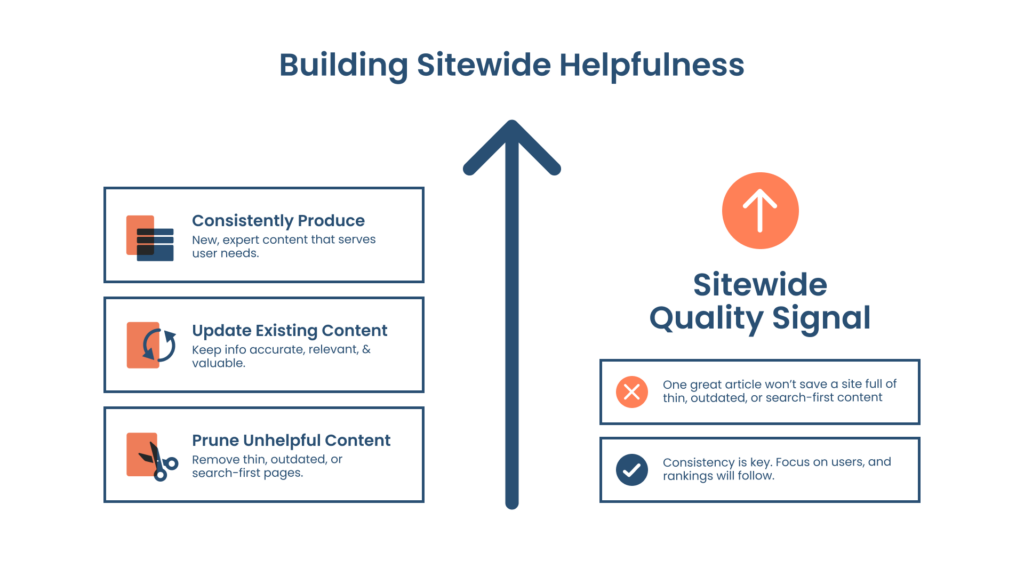
Remember that post-Helpful Content Update, “helpful content” is a sitewide signal—Google evaluates the average quality of every URL on your domain. This means you need to:
- • Consistently produce helpful content that demonstrates expertise and serves user needs
- • Update existing content to keep it accurate, relevant, and valuable
- • Prune content that no longer serves users or meets helpful content standards
One great article won’t overcome a site full of thin, outdated, or search-first content. Helpfulness is built through consistency. When you focus on what’s genuinely helpful for users, it becomes easier to rank well in search engines.
Need help creating helpful content?
At Digital Hitmen, we’re an SEO agency with a proven track record of producing results through high-quality, helpful content. Our approach has earned industry recognition:
- • Winner 2023 “Best Blog” – Semrush Search Awards Australia for our work on Online Flooring Store
- • Global Digital Excellence Awards 2025 – Standout Use of AI (Winner) for Discovery Alert, where we applied this framework to optimise AI content at scale
Whether you need help auditing your existing content, developing a helpful content strategy, or producing content that meets Google’s standards, our on-page SEO specialists at our SEO agency in Perth are here to help.
About the author:Ghazy Aziz is a performance-focused SEO and SEM specialist known for delivering award-winning campaigns that increase search visibility, drive qualified traffic, and maximise ROI across a wide range of industries.