
Understanding Search Experience Optimisation (SXO)
Understanding Search Experience Optimisation (SXO)
Posted on: February 16, 2026 | Written by: Ghazy Aziz, Digital Hitmen
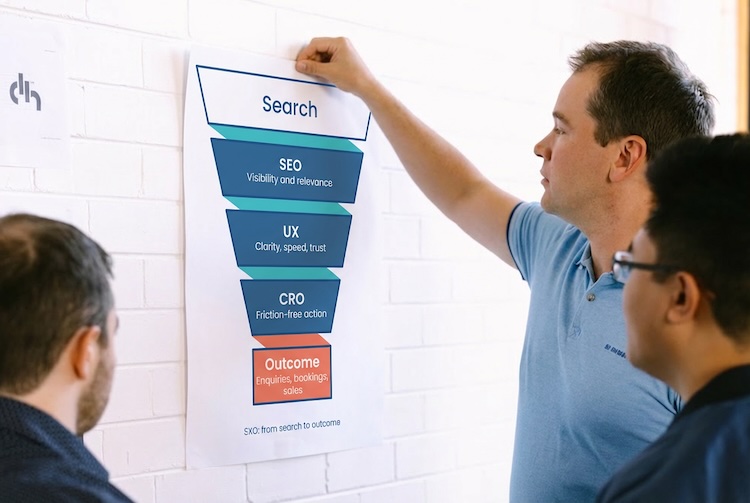
Search experience optimisation is the practice of improving the full journey from a Google search to a real outcome on your website (like an enquiry, booking, call, or purchase).
In plain terms: SEO helps users find you in organic search, and search experience optimisation makes it easy for them to trust you, use your site, and take the next step.
If you think of your website like a shopfront, SEO helps users find the right street and walk through the door. Search experience optimisation makes sure the shop is easy to navigate, the signs make sense, and the checkout works, so user satisfaction stays high and conversions follow.
In this blog, we break down what SXO is, how to apply it, and whether it’s a gimmick label or simply what good SEO should already include.
Quick summary
- • Search experience optimisation combines SEO, user experience (UX), and conversion rate optimisation (CRO) to improve results after the click.
- • It focuses on user intent, relevant content, clarity, site performance, trust signals, and conversion pathways.
- • Google looks for an overall great page experience and uses multiple signals, not one “magic” metric.
- • The fastest way to win is to improve what happens after the click: match intent, remove friction, and guide users to the next step.
- • Done properly, SXO helps boost conversions, increase engagement, and support search engine rankings over time.
What is Search Experience Optimisation (SXO)?
Search Experience Optimisation or SXO (alternatively “Search Experience Optimization if you use US-spelling) is the practice of improving the full journey from a Google search to a real outcome on your website, like an enquiry, booking, call, or purchase.
It combines three things:
- • SEO to earn visibility in search
- • User experience (UX) to make the page easy to use and understand
- • Conversion optimisation (CRO) to make the next step clear and friction-free
A simple way to frame it:
SEO gets you the click. SXO makes that click count.
Key components of SXO
1) Search intent match
SXO starts with user intent. Every search query has a job behind it. The page needs to do that job better than the alternatives.
Strong intent match looks like this:
- • The first screen confirms the user is in the right place
- • The content answers the main question quickly, then expands
- • The page includes the decision details people need to move forward (price cues, inclusions, timelines, comparisons)
If users search to compare, they need options and clear differences. If they search to buy, they need confidence, proof, and a simple next step. This is how relevant content supports better user satisfaction and, over time, stronger search engine rankings.
2) SERP experience (earning the click)
SXO starts before the visit, in organic search results:
- • Titles and meta descriptions that set the right expectation
- • Snippets that show relevance quickly (clear benefit, clear angle)
- • Structured results where appropriate (reviews, or product snippets like shipping times)
If users find your result but do not click, your listing is not aligning with intent. If they click and leave quickly, the page is not delivering on the promise.
3) On-page clarity and usability
Once the user lands, the page should be simple to understand and simple to use. This is the “can users find what they need quickly?” test.
Improve:
- • Clear headings and scannable sections
- • Short paragraphs and bullet points where they help
- • A layout that works properly on mobile
- • Content order that reflects what the user needs first
Good SXO is not about adding more content. It is about removing confusion, keeping the page focused, and using structure to guide users to the answer and the next step.
Learn more: What is on-page SEO and how do you improve it?
4) Page experience and performance
Performance supports experience. Slow pages, shifting layouts, and laggy interactions change user behaviour fast and usually reduce higher engagement and conversions.
Core Web Vitals targets commonly used:
- • LCP: 2.5 seconds or less
- • INP: 200 ms or less
- • CLS: 0.1 or less
INP replaced FID as a Core Web Vital on 12 March 2024.
Treat speed and stability as conversion and trust work first. Any SEO upside is a bonus.
5) Trust and confidence
Even when the page is relevant, people still ask themselves: “Can I trust this?”
Practical trust signals:
- • Reviews close to the CTA (not buried at the bottom)
- • Clear expectations (service areas, timelines, inclusions, returns, warranty)
- • Proof points (case studies, credentials, examples of outcomes)
- • Easy ways to contact you
Trust is a core reason SXO ensures the click turns into a lead or sale.
6) Conversion pathway
SXO is where SEO meets decision-making, and this is where outcomes happen. The page should make the next step obvious, and feel low-risk.
A strong conversion pathway usually includes:
- • One clear primary action per page
- • Supporting secondary actions that match the stage (compare, check pricing, download, enquire)
- • Forms that feel easy (short, clear, low-risk)
- • CTAs placed at decision points, not just at the bottom
Typical SXO goals and metrics
SXO is measured by outcomes, not by rankings alone. The clean way to track it is in three layers.
1) Search performance metrics (before the click)
- • Impressions
- • Clicks
- • Click-through rate (CTR)
- • Average position
These show whether your pages are being surfaced in organic search, and whether your result is convincing enough to win the click for that search query.
2) Experience metrics (after the click)
Use these as diagnostic signals (not as “ranking factors”):
- • Engagement rate (GA4)
- • Scroll depth (if tracked)
- • Key page interactions (click-to-call, filter use, pricing tab clicks)
- • Drop-off points (where people exit)
Behavioural tools like heatmaps, session recordings (you can use a free tool like Microsoft Clarity for this), and split tests can help you spot friction and validate changes, especially when engagement is high but conversions are not.
These help you understand user satisfaction and user behavior. If engagement is low, it usually means the content does not match user intent, or the page experience is getting in the way.
3) Outcome metrics (business results)
- • Enquiries, calls, bookings, purchases
- • Conversion rate per landing page
- • Lead quality indicators (qualified vs unqualified, requires manual review)
- • Assisted conversions (organic supporting the final action)
Quick diagnostic (use this to triage pages fast):
- • High rankings, low CTR: your snippet or intent match is off.
- • High traffic, low conversions: trust, clarity, or the conversion pathway is weak.
- • High engagement, low leads: the CTA, offer, or next step is not clear enough.
A combination of Google Search Console and GA4 is enough to assess the above if you need a free tool to review how you perform.
Key differences between SXO vs SEO
AreaSEO FocusSXO Focus
Primary goal
Visibility and traffic
Outcomes (leads, sales, bookings)
Success metrics
Rankings, impressions, clicks, CTR
Engagement, conversion rate, assisted conversions, revenue
Main question
“Can we rank?”
“Did we solve the user’s problem and move them forward?”
What it improves
Content targeting, crawlability, authority
Content clarity, usability, trust, speed, conversion flow
SEO is often treated as “rankings and traffic”.
SXO treats SEO as only one part of the job.
SEO focus
- • Visibility
- • Rankings
- • Traffic growth
SXO focus
- • The right click (not just more clicks)
- • The right experience (intent, clarity, speed, trust)
- • The right outcome (conversion and lead quality)
How to implement an SXO strategy
Here is the practical workflow I use when incorporating UX and CRO best practices with SEO:
Step 0: Quick SXO checklist (first pass on any landing page):
- • Confirm intent in the first screen (make it obvious they are in the right place).
- • Remove distractions above the fold (keep one clear primary next step).
- • Add trust near the CTA (reviews, proof, process, expectations).
- • Make mobile navigation effortless (no hunting for basics).
- • Fix obvious LCP and CLS issues on key pages (slow or jumpy pages kill momentum).
- • Reduce form friction (short, clear, low-risk).
- • Use internal links that guide users to the next decision page (not random links).
Step 1: Pick the pages that matter
Start with:
- • High impressions, low CTR pages (snippet or relevance issue)
- • High traffic, low conversion pages (experience or trust issue)
- • Money pages stuck on page 2 (often need both SEO and page improvements)
Step 2: Confirm intent using the live search results
Look at what ranks now and ask:
- • Are the top results guides, service pages, category pages, tools, or comparisons?
- • What information do they include early?
- • What objections do they solve?
Step 3: Fix the first screen first
Your above-the-fold section should do three things:
- • Confirm relevance in plain language
- • Give a quick answer or clear direction
- • Present the next step with confidence (CTA + trust cue)
Step 4: Make the content easy to scan
- • Descriptive H2s based on real questions
- • Bullets for benefits, steps, inclusions
- • Short paragraphs
- • Comparisons and summaries where users need them
- • Internal links that guide people to the next decision page
Step 5: Remove friction (UX and performance)
Use the “real user” lens. If it slows users down or makes the page harder to use, fix it.
High-impact areas:
- • CLS issues from late-loading banners, fonts, and sliders
- • LCP issues from heavy hero images and render-blocking scripts
- • INP issues from too much JavaScript and slow interactions
Step 6: Strengthen trust at decision points
Examples:
- • Reviews next to the CTA
- • Credentials near pricing or strong claims
- • Case studies near service promises
- • FAQs that answer real objections (not generic filler for the sake of stuffing keywords)
Step 7: Measure, iterate, roll out patterns
Treat changes like tests:
- • Change one meaningful element
- • Measure impact
- • Apply the pattern across similar page templates
Search Experience Optimisation example
A conventional eCommerce SEO approach often focuses on expanding category pages, adding more content, and improving keyword coverage. The problem is that this assumes rankings alone drive results.
In practice, this approach breaks down when users land on pages that are hard to navigate, unclear on mobile, or poorly structured. Traffic increases, but users struggle to move through the site, compare products, or reach checkout. SEO creates visibility, but UX determines whether that visibility turns into sales.
In our work for Online Flooring Store growth came from treating UX, site structure, and SEO as one system rather than separate efforts.
An SXO-led approach in this case focused on:
- • SEO and content aligned to early-stage intent: A structured keyword and content strategy was designed to capture users from their initial searches, ensuring the site matched how people research flooring online rather than just ranking for isolated terms.
- • Calls to action that guide progression, not just clicks: CTAs were redesigned and repositioned to actively guide users through the buying journey. Instead of leaving users to work out the next step, the site directed them toward purchase-relevant actions.
- • Checkout optimisation to protect SEO-driven demand: The checkout process was restructured and streamlined to reduce drop-off at the final stage. This ensured the value created by SEO and content work was not lost at conversion.
Why this matters
SEO without UX captures attention but leaks value. In this case, growth came from ensuring every stage after the search click was deliberately designed to move users forward.
That alignment between search intent, on-site guidance, and checkout experience led to measurable results:
- • 327% increase in online sales
- • 704% increase in organic traffic
- • 307% increase in page views
This is the practical difference between ranking for demand and converting it.
Benefits of Search Experience Optimisation
When SXO is done properly, you typically get:
- • Higher CTR from the same rankings (better snippets and relevance)
- • Better conversion rates without needing more traffic
- • Better lead quality because expectations are clear
- • Stronger trust and brand preference
- • More resilience when competitors copy keywords but not experience
Is Search Experience Optimisation the future of SEO?
It’s hard to say that this is “the future” when UX is supposed to be a core part of SEO to begin with.
Personally, I’m not a fan of the premise that optimising for UX on top of SEO is a wholly new thing that warranted an entirely new gimmick and abbreviation, especially when UX best practices have always been intended to be part of SEO.
We know this because Google has been pushing experience for years. Core Web Vitals are used by ranking systems, and Google recommends achieving good scores (while also being clear that good scores don’t guarantee top rankings and that page experience is broader than Core Web Vitals alone).
On top of that, the May 2024 leak of Google Search API documentation was widely analysed in the SEO industry and reinforced what many SEOs already believed: Google tracks and uses various interaction-related signals in its systems, even if the exact weighting and usage is not fully clear from the leak alone.
Good SEOs (should) already take good UX into account, and that’s always the approach we take in our campaigns.
However, given the nature of the industry, you’d be surprised how many still don’t properly optimise for experience. Which is why I believe the term SXO was able to exist in the first place.
So if you ask me if SXO is the future, it should be. Good SEO is intended to be SXO regardless, but it’s often not the case, so I understand why the term was even made (though I still dislike that a term has to be reserved for it).
FAQs
What is Search Experience Optimisation (SXO)?
SXO improves the journey from search to outcome by combining SEO, UX, and CRO. It aims to earn the click and make it easy for visitors to trust the page and take action.
How does SXO differ from SEO?
SEO is often measured by rankings and traffic. SXO focuses on what happens after the click, including intent match, clarity, trust, and conversion rate.
Do Core Web Vitals matter for SXO?
Yes. Core Web Vitals measure real-world experience (loading, responsiveness, stability), and Google says they are used by ranking systems. But Google also states that good scores do not guarantee top rankings and that there is more to page experience than Core Web Vitals alone.
How does SXO help improve organic search performance?
It improves what happens before and after the click. Better intent match, clearer relevant content, stronger trust signals, and higher engagement usually lead to better outcomes from organic search, even when rankings do not change overnight.
What are quick SXO wins that usually boost conversions?
Clear above-the-fold messaging, fewer form fields, stronger CTAs placed at decision points, faster load times, and trust cues near the CTA are the usual first wins. These changes guide users and reduce drop-offs.
About the author:Ghazy Aziz is a results-driven SEO and SEM specialist known for delivering high-impact, award-winning campaigns that improve search visibility, increase rankings, and maximise ROI across a wide range of industries. With a strong performance focus, he develops data-led strategies that translate directly into measurable business growth.